
Description
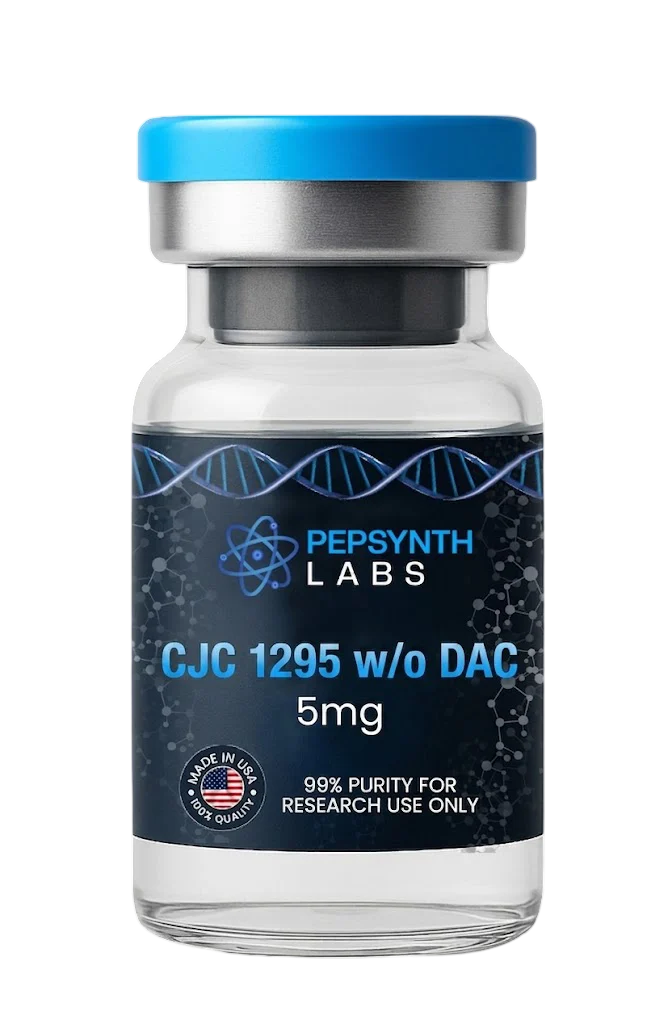
CJC-1295 w/o DAC 5mg Peptide
CJC-1295 w/o DAC is a peptide that researchers posit may function similarly to growth hormone-releasing hormone (GHRH), potentially increasing the endogenous production of growth hormone (GH) within the organism. The CJC-1295 w/o DAC peptide is a synthetic 29 amino acid analog of GHRH.(1) It is the shortest functional analog of GHRH that still has the potential capacity to trigger GH release from the somatotroph cells in the pituitary gland. Moreover, 4 of the original 29 amino acids in this fragment are substituted in CJC-1295 w/o DAC to possibly improve the pharmacokinetics of the peptide.
This does not imply that CJC-1295 w/o DAC has no relevance or use in present day research. For example, CJC-1295 w/o DAC & Ipamorelin blend has been studied for its suggested synergistic potential, as combining GHRH analogs with peptides that appear to activate the ghrelin receptors in the pituitary gland. It is also posited to result in greater GH-synthesis response from the somatotroph cells.(3)
OverviewCJC-1295 w/o DAC is recognized by many names: CJC-1295 without DAC, Mod GRF 1-29, tetrasubstituted GRF 1-29, and synthetic GHRH analog. Theoretically, as the peptide is considered a releasing factor for growth hormone, CJC-1295 w/o DAC has been studied for its potential role in:The reduction of fat mass by using fat cells as an energy source. It may lead to increased muscle mass via the promotion of protein synthesis.
Since growth hormone is considered to promote bone growth and improved joint and connective tissue, CJC-1295 w/o DAC peptide may potentially improve bone mass and thereby reduce the risk of damage.
Studies have suggested that GHRH may support the centers in the nervous system for sleep, and potentially this action may be mirrored by analogs like CJC-1295 w/o DAC.(4)
Since growth hormone is considered to promote bone growth and improved joint and connective tissue, CJC-1295 w/o DAC peptide may potentially improve bone mass and thereby reduce the risk of damage.
Studies have suggested that GHRH may support the centers in the nervous system for sleep, and potentially this action may be mirrored by analogs like CJC-1295 w/o DAC.(4)
Chemical Makeup
Molecular Formula: C152H252N44O42
Molecular Weight: 3367.95 g/mol
Other Known Titles: Tetrasubstituted GRF 1-29
Molecular Weight: 3367.95 g/mol
Other Known Titles: Tetrasubstituted GRF 1-29
Research and Clinical Studies
CJC-1295 w/o DAC Peptide Mechanism of Action
Researchers conducted two clinical studies in 2006 to examine the action of CJC-1295 analogs. In the first study, CJC-1295 or a placebo was presented in one of four ascending concentrations. In the second study, CJC-1295 was presented repeatedly at a single concentration. According to the results, after the introduction of CJC-1295 analogs, there appeared to be an increase in GH and insulin-like growth factor-1 (IGF-I) levels among the research models.(5) CJC-1295 w/o DAC is thought to elevate levels of IGF-1 by increasing growth hormone production, which in turn may bind to receptors on liver cells, potentially triggering a cascade of intracellular signaling processes. This binding might activate the Janus kinase-signal transducer and activator of the transcription (JAK-STAT) signaling pathway. Subsequently, the activated STAT proteins might migrate to the nucleus, where they may attach to specific DNA sequences considered to be response elements, potentially resulting in the transcription of the IGF-I gene. It is theorized that the IGF-I produced in liver cells may be transported to various target tissues. Additionally, it is believed that many tissues possess GH receptors, which, upon activation, may lead to the production of IGF-I within the tissues themselves. IGF-I is considered a potent hormone that may play a key role in promoting growth, suggesting it mediates many growth and anabolic effects of growth hormone. It is hypothesized to encourage cell growth and proliferation, as well as the enlargement and strengthening of tissues and organs, possibly aiding in protein synthesis and cellular expansion. Preliminary exposure to CJC-1295 w/o DAC in experimental models has been suggested to significantly affect average growth hormone levels, with studies reporting an apparent increase of 2- to 10-fold for shorter durations consistent with its pharmacokinetics. Moreover, CJC-1295 w/o DAC has been suggested to lead to dependent increases in average IGF-I levels by 1.5- to 3-fold for shorter windows, with suggestions that IGF-I levels may remain elevated in line with its profile in experimental models. Following repeated exposure to CJC-1295 w/o DAC, average IGF-I levels appear to follow patterns consistent with frequent dosing protocols.(5)
In 2006, another group of scientists assessed the GH pulsatility after a single occurrence of CJC-1295 analogs. They found out that there appeared to be an increase of about 50% in mean GH secretion and IGF-I levels after a single presentation of CJC-1295 analogs.(6) Researchers have suggested that the peptide might contribute to an increase in peak growth hormone levels by as much as 7.5 times in the models studied.(6) It seems that CJC-1295 w/o DAC may interact with certain binding sites on the growth hormone-releasing hormone (GHRH) receptor protein. This interaction may lead to changes in the receptor’s structure, potentially triggering a series of molecular processes. This interaction is believed to stimulate specific intracellular signaling proteins, often referred to as G-proteins.(7) Upon activation, these proteins may promote the production of secondary messengers, such as cyclic adenosine monophosphate (cAMP) or inositol trisphosphate (IP3), which are considered to play crucial roles in cellular signaling pathways.(8) Secondary messengers, including cAMP, are thought to activate protein kinases, which are enzymes considered capable of modifying specific proteins. These kinases are considered able to regulate cellular functions by phosphorylating transcription regulators, the proteins responsible for controlling gene expression. Once phosphorylated, these transcription regulators are speculated to move into the nucleus of somatotroph cells, where they might influence the genes involved in the production of growth hormone. This intricate cascade of events highlights the potential of CJC-1295 w/o DAC to modulate growth hormone levels through a complex network of molecular interactions.
Additional animal studies were conducted to evaluate the potential of CJC-1295 analogs. One study evaluated murine models presented with either the peptide or a placebo. The researchers concluded that exposing the murine models daily to CJC-1295 analogs might completely normalize growth. Another finding was that CJC-1295 analogs presented every 2 or 3 days appeared to produce intermediate results, indicating a probable interval-dependent action.(9) Furthermore, this study suggests that CJC-1295 w/o DAC might potentially impact body composition, seemingly by increasing muscle tissue hypertrophy while not impacting, or even possibly reducing, fat tissue levels. The murine models in this study appeared to have a deletion of the GHRH gene (referred to as GHRHKO); observations suggested that CJC-1295 w/o DAC may boost GH synthesis, leading to a beneficial alteration in body composition. Exposure to CJC-1295 w/o DAC in these GHRHKO murine models appeared to preserve normal levels of lean mass, unlike in models that were not exposed and exhibited suboptimal lean mass levels. Furthermore, the amount of subcutaneous fat mass stayed consistent with control levels in all groups associated with the peptide, whereas GHRHKO murine models without CJC-1295 w/o DAC exposure exhibited signs of increased fat levels. This indicates that CJC-1295 w/o DAC might positively affect muscle and bone structure without promoting an increase in fat accumulation. Additionally, the study noted a possible increase in pituitary RNA and GH mRNA levels following CJC-1295 w/o DAC exposure, suggesting an enhanced presence of somatotroph cells—those believed to produce growth hormone in the pituitary gland. The authors commented that “CJC-1295 caused an increase in total pituitary RNA and GH mRNA, suggesting that proliferation of somatotroph cells had occurred, as confirmed by immunohistochemistry images.” (9)
CJC-1295 w/o DAC Peptide Half-lifeCJC-1295 w/o DAC does not utilize the Drug Affinity Complex (DAC) technology. Contrary to GHRH, which is considered to boast a half-life of approximately 7 minutes, researchers report CJC-1295 w/o DAC to exhibit a longer half-life of 30 minutes due to its truncated 29 amino acid fragment, and 4 of the original amino acids in this fragment are replaced. Alterations to the peptide structure, specifically at the 2nd, 8th, 15th, and 27th amino acid positions, are thought to potentially improve the peptide’s stability against breakdown by the enzyme dipeptidyl peptidase-4. These alterations are detailed as follows:
- At the 2nd position, L-alanine is substituted by D-alanine, a change believed to bolster resistance against enzymatic degradation.
- At the 8th position, asparagine is replaced with glutamine, a modification that might reduce the risk of asparagine rearrangement and amide hydrolysis.
- The substitution of glycine with alanine at the 15th position is theorized to enhance the peptide’s bioactivity.
- The alteration from methionine to leucine at the 27th position is considered to potentially prevent methionine oxidation.
These modifications aim to enhance the peptide’s resilience and functional efficacy by mitigating enzymatic degradation and improving stability under physiological conditions.(10)
CJC-1295 w/o DAC peptide is available for research and laboratory purposes only. Please review and adhere to our Terms and Conditions before ordering.
References:
- Henninge J, Pepaj M, Hullstein I, Hemmersbach P. Identification of CJC-1295, a growth-hormone-releasing peptide, in an unknown pharmaceutical preparation. Drug Testing and Analysis. 2010 Nov-Dec;2(11-12):647-650. DOI: 10.1002/dta.233.
- Jetté L, Léger R, Thibaudeau K, Benquet C, Robitaille M, Pellerin I, Paradis V, van Wyk P, Pham K, Bridon DP. Human growth hormone-releasing factor (hGRF)1-29-albumin bioconjugates activate the GRF receptor on the anterior pituitary in rats: identification of CJC-1295 as a long-lasting GRF analog. Endocrinology. 2005 Jul;146(7):3052-8. doi: 10.1210/en.2004-1286. Epub 2005 Apr 7. PMID: 15817669.
- Sinha DK, Balasubramanian A, Tatem AJ, Rivera-Mirabal J, Yu J, Kovac J, Pastuszak AW, Lipshultz LI. Beyond the androgen receptor: the role of growth hormone secretagogues in the modern management of body composition in hypogonadal males. Transl Androl Urol. 2020 Mar;9(Suppl 2):S149-S159. doi: 10.21037/tau.2019.11.30. PMID: 32257855; PMCID: PMC7108996.
- Steiger A, Holsboer F. Neuropeptides and human sleep. Sleep. 1997 Nov;20(11):1038-52. PMID: 9456470.
- Teichman SL, Neale A, Lawrence B, Gagnon C, Castaigne JP, Frohman LA. Prolonged stimulation of growth hormone (GH) and insulin-like growth factor I secretion by CJC-1295, a long-acting analog of GH-releasing hormone, in healthy adults. J Clin Endocrinol Metab. 2006 Mar;91(3):799-805. doi: 10.1210/jc.2005-1536. Epub 2005 Dec 13. PMID: 16352683.
- Ionescu M, Frohman LA. Pulsatile secretion of growth hormone (GH) persists during continuous stimulation by CJC-1295, a long-acting GH-releasing hormone analog. J Clin Endocrinol Metab. 2006 Dec;91(12):4792-7. doi: 10.1210/jc.2006-1702. Epub 2006 Oct 3. PMID: 17018654.
- Martin, B., Lopez de Maturana, R., Brenneman, R., Walent, T., Mattson, M. P., & Maudsley, S. (2005). Class II G protein-coupled receptors and their ligands in neuronal function and protection. Neuromolecular medicine, 7(1-2), 3–36. https://doi.org/10.1385/nmm:7:1-2:003
Newton, A. C., Bootman, M. D., & Scott, J. D. (2016). Second Messengers. Cold Spring Harbor perspectives in biology, 8(8), a005926. https://doi.org/10.1101/cshperspect.a005926 - Alba M, Fintini D, Sagazio A, Lawrence B, Castaigne JP, Frohman LA, Salvatori R. Once-daily administration of CJC-1295, a long-acting growth hormone-releasing hormone (GHRH) analog, normalizes growth in the GHRH knockout mouse. Am J Physiol Endocrinol Metab. 2006 Dec;291(6):E1290-4. doi: 10.1152/ajpendo.00201.2006. Epub 2006 Jul 5. PMID: 16822960.
- Van Hout MC, Hearne E. Netnography of Female Use of the Synthetic Growth Hormone CJC-1295: Pulses and Potions. Subst Use Misuse. 2016 Jan 2;51(1):73-84. doi: 10.3109/10826084.2015.1082595. Epub 2016 Jan 15. PMID: 26771670.
- ClinicalTrials.gov, A service of the US National Institutes of Health. Available at: http://clinicaltrials.gov/ct2/show/NCT00267527 (27 June 2010).

Reviews
There are no reviews yet.